1. The 1756 Demarcation: The World's First Regulated Appellation
In 1756, Sebastião José de Carvalho e Melo, then Count of Oeiras and later Marquês de Pombal, instituted the Companhia Geral da Agricultura das Vinhas do Alto Douro by royal decree. Countering rampant adulteration and British merchant cartels that had depressed regional farm-gate prices, the crown established the world’s first formal system of regional wine demarcation and quality classification.
To enforce the territorial boundaries, 335 massive granite boundary stones—known as marcos pombalinos—were carved and driven into hilltops throughout the valley between 1757 and 1761. Only grapes cultivated within this physical perimeter were legally permitted to yield vinho de feitoria, the premium fortified wine destined for export across the British Empire.
2. Barcos Rabelos: Naval Architecture for Treacherous Currents
The geography of the virgin Douro was vicious: shallow shoals, whirlpools, and narrow rock gaps that made conventional deep-draft keeled vessels useless. To meet this challenge, Portuguese shipwrights perfected the barco rabelo, an indigenous wooden cargo vessel uniquely adapted to white-water rapids.
Architectural Specifications of the Classic Barco Rabelo
| Design Feature | Engineering Specification | Functional Purpose in River Transit |
|---|---|---|
| Hull Architecture | Flat-bottomed pine and oak construction; length 19–23 m | Enables passage over shallow sandbars and rocky river shelves without grounding |
| Steering Mechanism | The espadela: a long rear sweep oar measuring 8–10 m | Provides immediate lateral leverage to wrench the vessel out of violent whirlpools |
| Sail Rigging | Single square-rigged cotton canvas sail on a flexible mast | Harnesses prevailing westerly river canyon breezes on the grueling return journey upstream |
| Cargo Capacity | 40 to 100 pipas (traditional oak casks holding ~550 L each) | Carried roughly 20 to 55 metric tons of fortified wine downriver per voyage |
| Return Towing | Towpath teams using oxen and human tracking gangs (sirga) | Took up to 14–20 arduous days to haul empty craft back against raging currents |
3. The Dual Cities: Porto and Vila Nova de Gaia
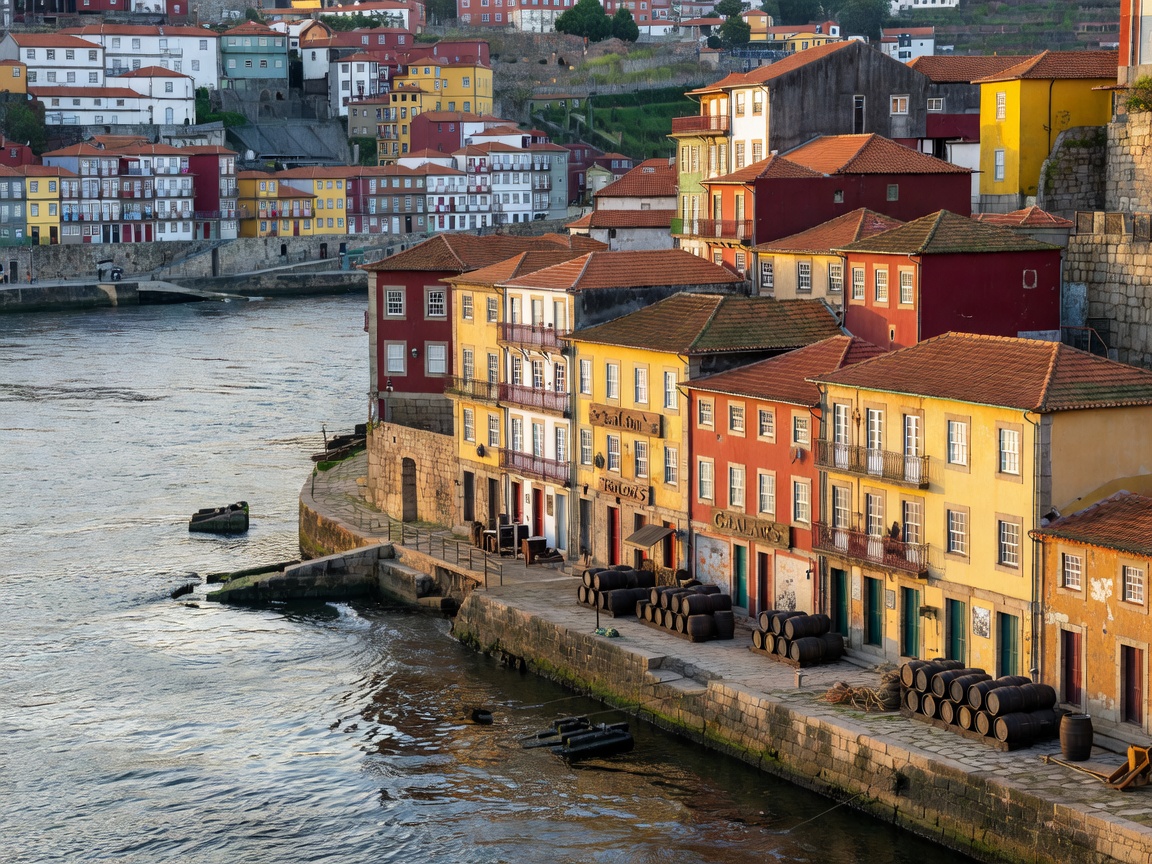
The destination for every laden rabelo was the twin urban hub flanking the river estuary. Porto, on the high granite northern bluff, served as the civic, administrative, and financial heart. Vila Nova de Gaia, on the gentler southern bank, became the physical staging ground for the wine itself.
This geographic segregation was deliberate. The south bank faced north toward the open ocean, shielded from direct midday heat. This cool, steady Atlantic marine air was essential for preventing the secondary refermentation of fortified wines aging inside enormous oak vats (tonéis) and pipes. Furthermore, merchants established their storage lodges in Gaia to escape the punitive municipal taxes levied by the Bishop of Porto during the medieval and early modern periods.
4. The British Treaty Dynamic: Methuen and the Shippers
The international prominence of the Douro’s wine culture was accelerated by geopolitics. The Treaty of Methuen, signed in 1703 between England and Portugal, granted preferential customs duties to Portuguese wines imported into London in exchange for open markets for English woolens. This preferential access stimulated an influx of British merchant houses whose names still adorn the lodge rooftops of Vila Nova de Gaia.
This cross-cultural trade spawned an entirely distinct Anglo-Portuguese mercantile culture. The Feitoria Inglesa (British Factory House) in Porto, constructed in 1790 by consul John Whitehead, still stands as an architectural testament to the palatial influence wielded by wine shippers during the Enlightenment.
5. The Displacement of River Freight: Rails & Roads
The perilous era of the barco rabelo came to an end with the construction of the Linha do Douro railway between 1873 and 1887, which offered reliable all-weather transport straight to the river quays. By the mid-1960s, tanker trucks and refrigerated rail wagons had completely replaced river cargo. Today, the surviving rabelo boats are meticulously maintained as floating living history museums along the Ribeira and Gaia quays, hoisting their sails each June during the colorful São João river regatta.