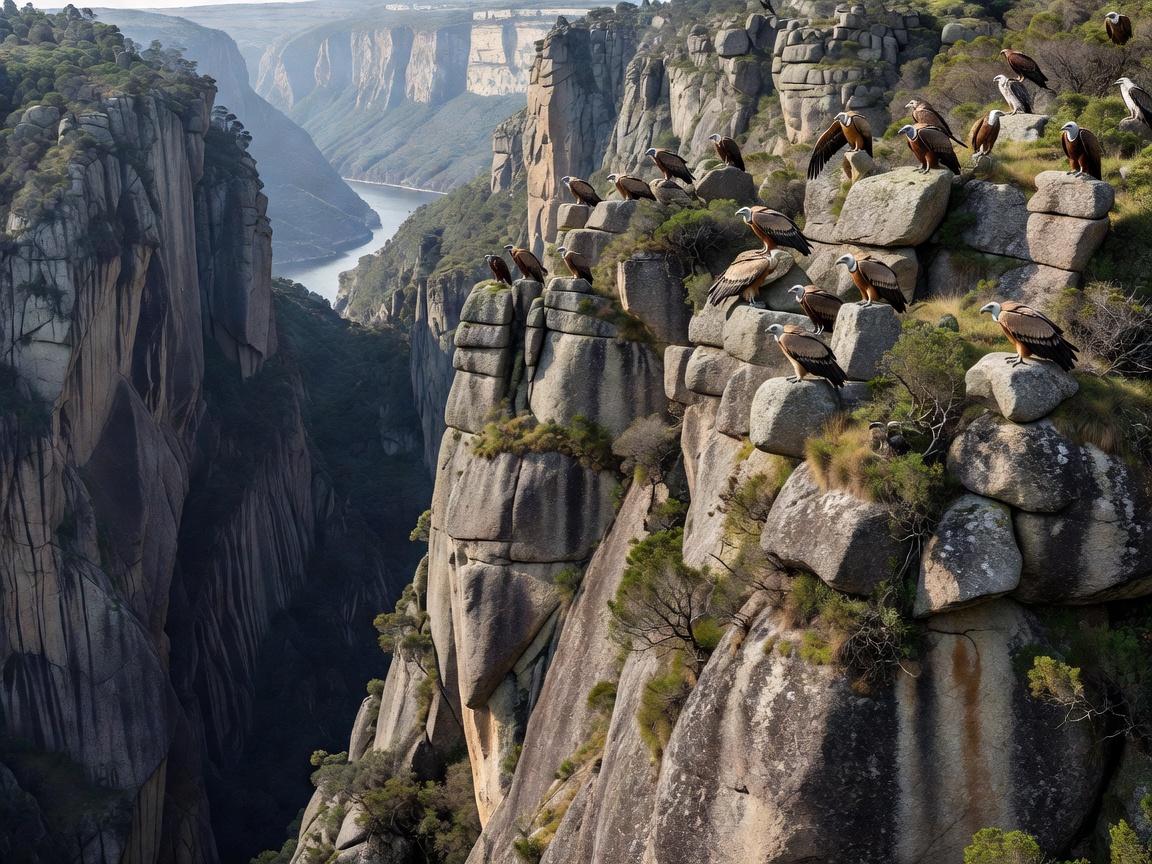
1. The Avian Haven of the Douro Internacional Natural Park
The protected corridor of the Parque Natural do Douro Internacional encompasses over 85,000 hectares along the Portuguese-Spanish border. Here, sheer vertical cliffs reaching over two hundred metres create completely predator-proof roosting platforms for rare ornithological communities.
Key raptor and cliff-dwelling bird populations documented in the gorge include:
- Egyptian Vulture (Neophron percnopterus): Known locally as britango, this migratory scavenger arrives in early spring from sub-Saharan Africa. The Douro canyon shelters one of Europe's dense breeding colonies.
- Griffon Vulture (Gyps fulvus): Massive resident colonies nest along the granite cornices, frequently seen circling on midday thermal currents above the canyon waters.
- Bonelli's Eagle (Aquila fasciata): A resident apex predator requiring undisturbed rocky crags and extensive hunting territories across adjacent oak savanna.
- Black Stork (Ciconia nigra): Far rarer and more reclusive than its white cousin, the black stork avoids human settlement, building its nests exclusively on sheer, inaccessible cliff ledges overhanging the river.
Ecological Health & Habitat Survey
| Ecological Sector | Dominant Species Observed | Conservation Status | Environmental Challenges |
|---|---|---|---|
| Riverine Cliffs | Egyptian Vulture, Black Stork, Peregrine Falcon | Strictly protected (Natura 2000 network) | Disturbance from motorized pleasure craft and extreme heatwaves |
| Aquatic Channel | Iberian Barbel, Boga, European Eel, River Trout | Vulnerable in upstream reaches | Dam barriers preventing upstream migration; invasive fish species |
| Valley Terraces | Ocellated Lizard, Iberian Wall Lizard, Praying Mantis | Stable across organic vineyards | Pesticide drift from non-certified plots; replacement of dry-stone walls |
| Mediterranean Scrub | Cork Oak, Holm Oak, Wild Olive, Juniper | Protected woodlands | Recurring wildfire risks during protracted Mediterranean droughts |
2. Endemic Fluvial Ichthyofauna and Dam Fragmentation
The native fish communities of the Douro represent extreme evolutionary adaptation to intense seasonal water level oscillations. Endemic cyprinid species including the Iberian Barbel (Luciobarbus bocagei) and the Northern Iberian Boga (Pseudochondrostoma duriense) historically undertook extensive spawning runs up tributary streams like the Sabor, Tua, and Côa.
The construction of hydroelectric dams transformed free-flowing turbulent waters into quiet lacustrine reservoirs. While fish ladders were retrofitted at select locks, their biological efficiency has varied. Conservation authorities currently maintain active breeding programs and artificial flow regimes to maintain oxygen levels and gravel spawning grounds below major dam outfalls.
3. Native Riparian Vegetation and Botanical Diversity
The flora of the valley exhibits sharp ecological division between the riverbank riparian margin and the steep mountain hillsides:
- Riparian Fringe: Narrow bands of black alder (Alnus glutinosa), narrow-leafed ash (Fraxinus angustifolia), and white willow (Salix alba) cling to the water's edge, anchoring silty banks against winter water release surges.
- Mediterranean Scrub (Zambujal): Beyond the immediate water line, the microclimate shifts to dry Mediterranean scrub dominated by wild olive (Olea europaea var. sylvestris), evergreen oak (Quercus rotundifolia), and mastic shrub.
- Rock Lichens and Flora: Rare rupicolous ferns and endemic lichens occupy micro-crevices in the schist and granite faces, surviving months of direct solar radiation without rainfall.
4. The Ecological Role of Organic Viticulture
Over the past twenty years, wine growers throughout the Alto Douro have increasingly acknowledged that biodiversity directly fortifies vineyard health. The restoration of dry-stone walls (socalcos) has proven vital: the loose unmortared stones provide year-round refuge for insectivorous geckos, lacertid lizards, and beneficial predatory arthropods that keep vineyard pests in balance without intensive chemical intervention.