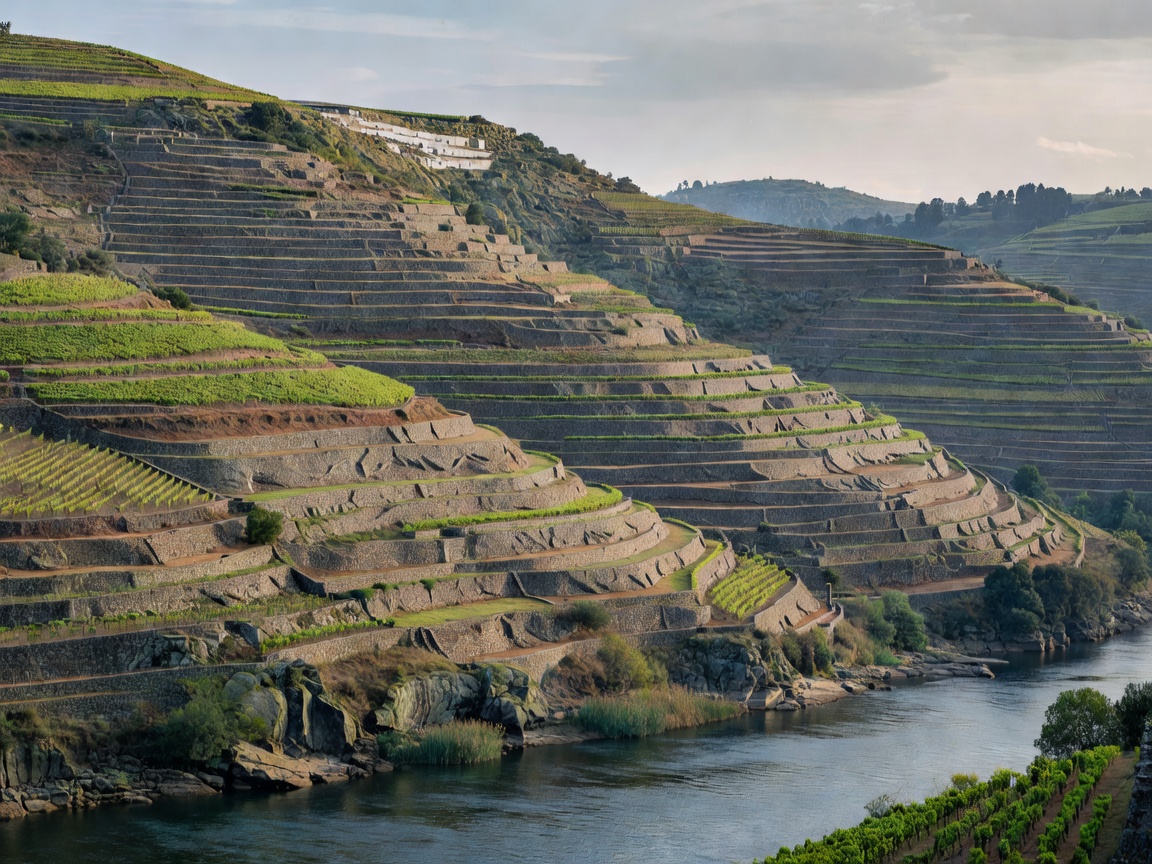
1. The Geological Core: Schist vs. Granite
The character of the Douro Valley is intimately governed by its geological substrate. While granite domes flank the outer perimeter at Vila Real and Amarante, the demarcated viticultural zone is etched primarily into ancient Cambrian and Ordovician schist formations.
Unlike impervious hard granite, Douro schist possesses vertical foliation planes. When winter precipitation strikes, rainwater infiltrates along these vertical fissures instead of washing off as violent surface runoff. In response, vine roots push down ten to twenty metres into the subterranean rock fractures to access moisture during scorching summer months when daytime temperatures routinely top 42°C.
2. Terracing Typologies: The Evolution of Hillside Architecture
The hillsides flanking the Douro feature three distinct historical terrace construction models, reflecting historical access to manual labour, mechanical tractors, and soil conservation mandates:
Architectural Comparison of Douro Terrace Systems
| Terrace System | Historical Origin | Construction Technique | Pros & Operational Strengths | Cons & Modern Challenges |
|---|---|---|---|---|
| Socalcos Tradicionais | Pre-phylloxera (17th–19th Century) | Dry-stone retaining walls stacked by hand without mortar | Unmatched thermal retention; zero soil runoff; exceptional microclimate control | Impossible to mechanize; extremely costly maintenance; high risk of wall collapse |
| Patamares | Post-1970 Modernization | Bulldozer-excavated earthen embankments without stone walls | Enables small tractor navigation; lower capital expenditure to plant | Greater exposure to erosion; loss of rock heat-sink benefit; lower planting density |
| Vinha ao Alto | Late 20th Century to Present | Vertical vine rows planted directly up the gradient (slopes < 40%) | Highest vine density per hectare; uniform solar exposure across canopy | Severe erosion risk during winter deluge; limited to milder hill gradients |
3. Climatic Sub-Zones: Baixo Corgo, Cima Corgo, Douro Superior
The mountain range of Serra do Marão acts as a meteorological shield, preventing damp Atlantic clouds from bathing the interior valleys in coastal rains. As one moves eastward along the river channel, precipitation drops drastically while summer aridity intensifies:
- Baixo Corgo (Lower Corgo): The wettest sub-region, receiving roughly 900 millimetres of annual rainfall around Peso da Régua. Produces lighter, fresher wines with vibrant acidity.
- Cima Corgo (Upper Corgo): Centred around the confluence at Pinhão. Rainfall averages 650 millimetres. This is the historic heartland of Vintage Port and concentrated single-quinta table wines.
- Douro Superior (Upper Douro): Extending from Valeira to the Spanish border. Rainfall drops below 400 millimetres, resulting in desert-like arid landscapes producing dense, opulent wines from low-yielding bush vines.
4. Engineering Spans: The Iconic Bridges of the Douro
No discussion of the Douro landscape is complete without its river spans, which conquered treacherous canyon crossings to link remote mountain settlements with Atlantic shipping depots:
- Ponte Dom Luís I (Porto & Gaia): Designed by Théophile Seyrig, a disciple of Gustave Eiffel, this dual-level wrought-iron arch bridge opened in 1886, spanning 172 metres across the deep river gorge.
- Ponte Maria Pia (Porto): Completed directly by Gustave Eiffel’s firm in 1877, this pioneering railway arch was once the largest wrought-iron span in the world.
- Ponte Metálica de Pinhão (Pinhão): Erected in 1906, connecting the left and right banks of the Cima Corgo through three graceful lattice-girder spans fabricated in industrial ironworks.
- Ponte de Ferro de São João da Pesqueira (Ferradosa): A monumental railway span carrying the historic Linha do Douro directly over the submerged bed of the former Cachão da Valeira.
5. Elevated Miradouros: Reading the Valley Topography
To truly grasp the scale of the human intervention in this landscape, one must observe it from high granite overlooks known as miradouros. Sites such as São Leonardo da Galafura—immortalized in the literature of Miguel Torga as an “excess of nature”—reveal thousands of undulating terraces curling like topographical fingerprints over hundreds of square kilometres.